
The Parent Teacher Student Association stands as a powerful space for collaboration. Parents join teachers and students to create a balanced ecosystem inside the school environment. Each voice holds equal value. Each role drives the academic and personal growth of the child. This structure forms a living network that supports real participation from all sides.
The traditional PTA excludes the student voice. The PTSA repairs that gap. Students guide important decisions. They bring new ideas. Students represent daily experiences that adults never observe. This gives the PTSA a rare position inside the educational structure.
The PTSA does not operate like regular administrative bodies. The PTSA works as a community-led think tank. Members use real experiences, day-to-day observations, and school realities to design solutions. The PTSA becomes a living laboratory of ideas instead of a silent committee.
How the PTSA Builds a Model of Shared Responsibility
Parents, teachers, and students carry different responsibilities. The PTSA merges these responsibilities into a single shared system. Every participant contributes in a practical way.
Parents Add Real-Life Perspective
Parents bring home values, emotional understanding, and cultural knowledge into the discussion. They understand stress patterns, learning habits, and behavioral changes that appear outside the school. Parents act as the bridge between school expectations and home realities.
Teachers Add Academic Expertise
Teachers bring classroom experience, learning strategies, and Supplemental Educational insight. They lead discussions based on curriculum demand, student performance, and classroom behavior. They evaluate ideas with a practical lens.
Students Add Peer-Level Insight
Students understand school life from the inside. They observe behavior, motivation shifts, social dynamics, and peer challenges. Students give honest feedback on rules, schedules, learning methods, and school climate. Their voice creates instant clarity. The PTSA combines these three perspectives and forms a complete picture.
Why Students Hold the Strongest Influence Inside a PTSA

Students understand the heartbeat of the school. They see everything in real time. Their observations carry raw data. Their suggestions come from direct experience. Students highlight invisible issues. Students share bright ideas that adults sometimes overlook.
Many PTSAs across the world recognize the power of student leadership. Students lead digital literacy programs. Students guide mental health awareness drives. They design peer-support systems. Students even participate in staff–student policy design. A PTSA that listens to students always identifies deeper issues faster than any administrative team.
The PTSA as a Community Innovation Hub

The PTSA can operate as a creative zone. Members test ideas, invent solutions, and introduce new systems without waiting for slow administrative decisions. This gives the PTSA a unique position in the school environment. Below are uncommon concepts that modern PTSAs now explore:
Student Skill Circles
Students teach students. Students conduct small workshops on skills they already know. Coding. Drawing. Robotics. Leadership. Debate. This removes hierarchy and builds confidence.
Parent Talent Labs
Parents bring professional skills to the school. Parents teach photography, baking, carpentry, financial planning, or resume writing. They offer real industry knowledge.
Teacher Insight Rounds
Teachers organize mini-sessions where they explain the psychology of learning. They share strategies that improve focus, memory, and discipline. Parents use the same strategies at home.
Community Micro-Projects
The PTSA assigns students real projects like improving the canteen menu, designing a school garden, or developing student-friendly safety rules. These projects introduce leadership and responsibility.
How the PTSA Creates a Culture of Voice Instead of Silence
Most school systems operate on silence. Students follow rules without speaking. Parents agree without debate. Teachers carry pressure without sharing struggles. The PTSA breaks this silence.
Inside PTSA meetings, each group expresses ideas openly. Each idea remains valid. No one holds more power based on title or age. Members discuss actual problems. Members work on solutions. Mostly Members support one another without judgment. This builds a culture of communication. This culture becomes the foundation of school progress.
Unique Problems the PTSA Can Solve That Schools Usually Ignore
Traditional school systems miss key problems. The PTSA catches them. These include:
Silent Bullying Patterns
Students identify hidden bullying cases that teachers cannot see.
Cultural Misunderstandings
Parents help teachers understand cultural behaviors that students bring from home.
Learning Gaps
Teachers and parents identify learning slowdowns and create faster solutions.
Emotional Pressure
Students reveal emotional stress created by academic overload, peer comparison, or social anxiety.
Ineffective School Policies
Parents offer home-based insight. Students offer experience-based insight. Teachers offer application-based insight. This combination repairs bad policies.
The PTSA’s Role in Mental Health and Emotional Safety
Mental health support grows when students join the conversation. Students detect anxiety trends inside their peer circle. They notice emotional changes in friends. They understand the silent signs of stress. Parents offer emotional support at home. Teachers offer support inside the classroom. The PTSA merges both to create a complete support system. A mental health strategy created by a PTSA carries accuracy. It carries compassion. Also carries relevance. It works faster than professional programs that operate from distance.
How the PTSA Helps Teachers Without Increasing Teacher Burden
Teachers already hold heavy responsibility. The PTSA works as a support team rather than an extra load.
Classroom Volunteer Rotation
Parents rotate to assist in nonteaching tasks. This removes extra stress from teachers.
Student Learning Partners
Students support classmates through peer learning circles. Teachers receive more time for targeted teaching.
Real-Time Feedback
Parents and students give quick feedback on new teaching methods. This helps teachers adjust faster.
Resource Pooling
The PTSA collects resources like books, supplies, tools, and materials. Teachers receive quicker access to classroom support.
How the PTSA Encourages Student Leadership
Leadership grows through responsibility. Students in PTSAs hold major responsibilities.
- They organize school events
- They manage student surveys
- They represent classmates
- They propose changes
- They evaluate school systems
This builds confidence, communication, planning, and decision-making skills.
The PTSA and Digital Age Challenges
Modern students live inside a world full of screens, notifications, and information overload. The PTSA adapts to these challenges through:
Digital Wellness Discussions
Students explain their struggles with screen addiction. Parents understand new digital trends. Teachers offer balanced guidelines.
Online Safety Workshops
Parents and teachers educate students about cyberbullying, privacy protection, and safe online behavior.
Tech-Driven Learning Methods
Teachers guide the group on modern learning tools. Parents test these tools at home. Students share results.
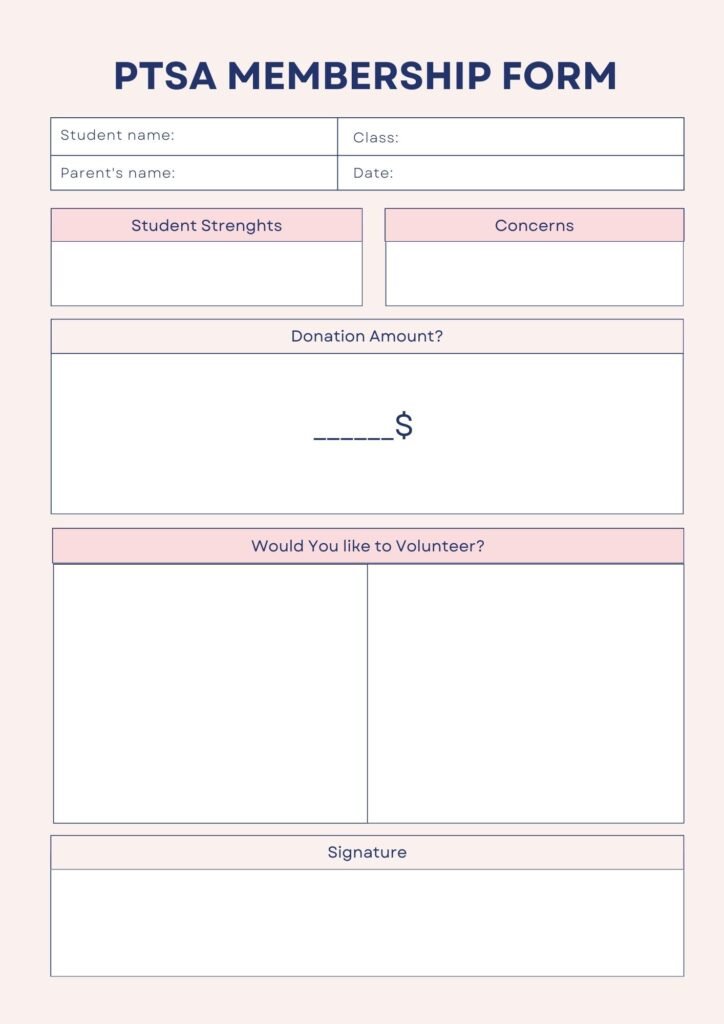
How to Fill Out the Parent Teacher Student Association Membership Form: Download the form here.
Follow each step carefully to complete the form correctly.
1. Fill in Parent/Guardian Information
Write your details clearly in the spaces provided.
- Full Name: Write the parent or guardian’s complete name.
- Email: Enter your active email address.
- Phone Number: Write a valid contact number.
- Address: Write your full home address.
If the form is being filled by a teacher or student instead of a parent, this section may be left blank depending on the school’s instructions.
2. Fill in Student Information
Enter the student’s school details.
- Full: Write the student’s full name.
- Grade: Write the student’s grade/class.
- Trade: If applicable, enter the student’s academic trade or section.
- Student ID (Optional): Write the student ID number (if available).
If the member is a teacher or staff member without a child enrolled, this section may remain empty.
3. Choose Your Membership Type
You must tick one box based on the category you belong to.
The options include:
- Parent/Guardian Membership
- Teacher Membership
- Staff Membership
- Student Membership
In your form example, Teacher Membership is checked.
Next to the selected membership type, write the Membership Fee amount in the blank space.
Example:
✔ Teacher Membership — Membership Fee: $20
4. Select Your Volunteer Interests
Tick any areas where you want to volunteer.
Options include:
- Event Planning
- Fundraising
- School Beautification
- Newsletter/Communications
- Committees (Specify):
- Other:
You can check one or several based on your interest.
If you select “Committees,” write the specific committee name on the line.
If you select “Other,” describe your skill or interest.
5. Add Additional Donation (Optional)
If you want to donate extra funds to support school programs, write the amount next to:
Additional Donation Amount: $ __________
If you don’t want to donate, leave it blank.
6. Sign the Form
At the bottom of the form:
- Write your signature on the signature line.
- Some schools may also require the student’s or teacher’s signature, depending on membership type.
Why the PTSA Outperforms Traditional PTA Systems
The PTSA stands stronger because it includes the student voice. The traditional PTA focuses on parents and teachers only. The PTSA includes the most important stakeholder.
Students become responsible for their environment. Parents understand school needs. Teachers gain real support. The PTSA evolves with changing school culture. The PTA remains limited.
Ways the PTSA Removes the Gap Between School and Home
The PTSA builds a smooth connection between home and school life.
- Parents understand academic expectations
- Teachers understand home challenges
- Students experience fairness and trust
Communication becomes clear. Misunderstandings decrease. Collaboration increases. During PTSA discussions and parent–teacher meetings, teachers often share the Progress Report Parent Letter to help parents understand their child’s academic growth. Children receive balanced guidance from both sides.
How a Strong PTSA Impacts Student Success
Students thrive when all three groups work together. A strong PTSA creates environments where:
- Students feel safe
- Students feel supported
- Students feel understood
- Students feel involved
This improves academic results, creativity, emotional stability, and motivation.
Building Better Schools Through PTSA Partnership
The Parent Teacher Student Association offers a complete approach to education. Parents add emotional depth. Teachers add academic expertise. Students add experience-based insight. Together, they form a dynamic team that shapes stronger school environments. The PTSA builds communication, leadership, safety, and innovation. Its community-driven structure creates real progress for every child.