
Benefiting or Benefitting: Correct Spelling, Meaning & Examples

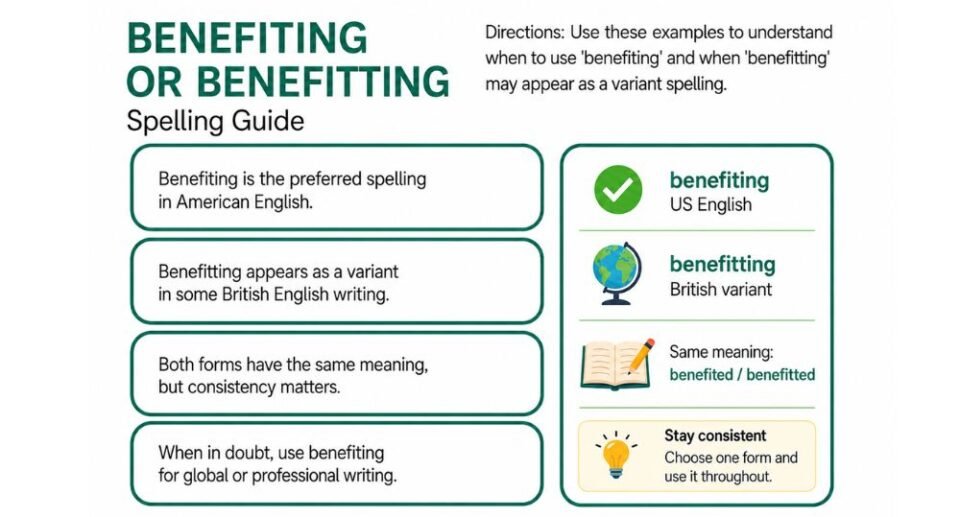
One small letter can make a word look wrong, even when it is not. That is exactly why many writers pause at benefiting or benefitting. The quick answer is this: both spellings are used, but “benefiting” is the safer and more common choice for American English and global writing. “Benefitting” is also accepted in some British English contexts, but it is less useful if you are writing for a broad audience. So, if you are writing a blog post, email, essay, report, or website article and you are not sure which spelling to choose, use:
benefiting
Example:
Students are benefiting from the new learning program.
That spelling will look natural to most readers, especially in American and international English.
What Does “Benefiting” Mean?
Benefiting means receiving help, gaining an advantage, or getting something useful from a situation.
It comes from the verb benefit, which means to help someone or to receive something helpful. Merriam-Webster defines a benefit as something that produces good or helpful results, and Cambridge gives a similar meaning: a helpful or good effect.
Here are a few simple examples:
- The company is benefiting from better customer service.
- Children are benefiting from healthier school meals.
- Small businesses are benefiting from online tools.
- She is benefiting from regular exercise.
In each sentence, someone or something is receiving a positive result.
Benefiting vs Benefitting: What Is the Difference?
The difference between benefiting and benefitting is not meaning. Both words mean the same thing. The difference is mainly spelling style. Benefiting is the preferred spelling in American English and is usually the better option for global readers.
Benefitting is accepted as a variant and is more likely to appear in British English or in writing that follows British-style spelling habits. Collins lists both benefiting or benefitting as present participle forms of benefit, and Merriam-Webster also notes benefitting as a variant of benefiting. So these two sentences mean the same thing:
- The charity is benefiting from local donations.
- The charity is benefitting from local donations.
The spelling changes, but the meaning does not.
Why Does the Extra “T” Cause So Much Confusion?
The confusion comes from a common English spelling rule, and simple language lessons can help readers understand why some spellings change while others stay the same.
When adding -ing or -ed to some verbs, English sometimes doubles the final consonant.
For example:
- admit → admitting
- permit → permitting
- begin → beginning
That happens because the final syllable is stressed.
But benefit is different. We usually stress the first part of the word:
BEN-e-fit
Because the final syllable is not stressed, American English normally does not double the final t. That is why benefit becomes benefiting and benefited in standard American usage. Future Perfect explains this clearly: benefit follows the normal rule and becomes benefiting/benefited because the preceding vowel is unstressed.
This is similar to:
- visit → visiting
- limit → limiting
- edit → editing
We do not usually write:
- visitting
- limitting
- editting
So, by that rule, benefiting makes sense.
When Should You Use “Benefiting”?
Use benefiting when you want the safest, cleanest, and most widely accepted spelling.
It is the better choice for:
- American English
- Global English
- Blog posts
- Website content
- Business emails
- Academic writing for international readers
- SEO content
- Professional documents
Examples:
- Our team is benefiting from the new workflow.
- Customers are benefiting from faster support.
- The city is benefiting from improved public transport.
- Students are benefiting from extra reading practice.
For most writers, this is the best default spelling.
When Can You Use “Benefitting”?
You can use benefitting when writing for a British English audience or when your chosen style guide accepts the double t form.
Examples:
- Local schools are benefitting from the new funding.
- The organisation is benefitting from stronger community support.
- Residents are benefitting from the council’s new housing plan.
This spelling is not meaningless or fake. It is a recognized variant. The important thing is to use it only when it fits your audience and style.
If your article is written in British English, you may already be using words like:
- colour
- centre
- organise
- programme
In that context, benefitting may feel more natural.
But if your content is for a US or global audience, benefiting is usually the better choice.
Benefited or Benefitted: The Same Pattern
The same spelling issue appears in the past tense.
The American English form is usually:
benefited
The British English variant is:
benefitted
Grammarly notes that both benefited and benefitted are acceptable, while benefited is more common in the United States. Collins also lists both past forms: benefited or benefitted.
Examples:
- She benefited from the training program.
- The company benefited from better planning. Schools and families benefited from better planning when everyone worked together to support student success.
- The charity benefitted from a generous donation.
- Local families benefitted from the support scheme.
Again, the meaning is the same. The difference is spelling preference.
The Most Important Rule: Stay Consistent
- The biggest mistake is not choosing benefiting or benefitting.
- The biggest mistake is mixing both in the same piece of writing.
- For example, this looks messy:
- The company is benefitting from the new strategy, and customers are benefiting from improved service.
- A better version would be:
- The company is benefiting from the new strategy, and customers are benefiting from improved service.
- Or, if you are using British-style spelling:
- The company is benefitting from the new strategy, and customers are benefitting from improved service.
- Consistency makes your writing look cleaner and more professional.
Easy Examples You Can Use
In an email
Correct:
Our team is benefiting from the new project management system.
Also acceptable in British style:
Our team is benefitting from the new project management system.
In business writing
Correct:
Customers are benefiting from faster delivery and better support.
In academic writing
Correct:
Students are benefiting from smaller class sizes and more individual feedback.
In everyday writing
Correct:
I am benefiting from waking up earlier and planning my day.
In a nonprofit context
Correct:
Local families are benefiting from the food assistance program.
Benefiting or Benefitting: Quick Decision Guide
Use benefiting if:
- You are writing for a US audience.
- You are writing for a global audience.
- You are writing website or blog content.
- You want the safest spelling.
- You are not following a specific British style guide.
Use benefitting if:
- You are writing mainly for a British English audience.
- Your editor or style guide prefers it.
- The rest of your content follows British spelling.
- You are staying consistent with benefitted.
When in doubt, choose benefiting.
FAQs About Benefiting or Benefitting
Yes, benefitting is accepted as a variant spelling, especially in some British English contexts. However, benefiting is usually the safer choice for American and global writing.
Yes, benefiting is the preferred spelling in American English. It is also widely used in global English.
Benefitting is more likely to appear in British English than American English, although British writers may also use benefiting.
Yes. Both words mean receiving help, gaining an advantage, or getting a useful result from something.
For SEO content targeting a global audience, benefiting is usually better. It is simpler, more widely recognized, and less likely to look unusual to readers.
Both forms exist. Benefited is preferred in American English, while benefitted is accepted as a British-style variant. The best choice depends on your audience and style.
The Simple Rule to Remember
If you are unsure whether to write benefiting or benefitting, choose benefiting. It is the safest spelling for most modern writing, especially if your readers are in the United States or spread across different countries. Use benefitting only when writing for a British-style audience or when your style guide prefers the double t. The meaning stays the same either way. What matters most is choosing one spelling and using it consistently.
Aashley Kai is the Editorial Director of Chelsea Famous Parenting and a licensed expert in early childhood education. She holds a Master’s in Child Psychology from the University of Texas Southwestern Medical Center and has worked as a preschool teacher and child therapist. Since joining in 2024, Aashley has been dedicated to creating well-researched, trustworthy parenting resources. Her work helps parents and caregivers foster nurturing, educational environments for children. Outside of work, she enjoys hiking and photography, capturing nature from a child’s perspective.